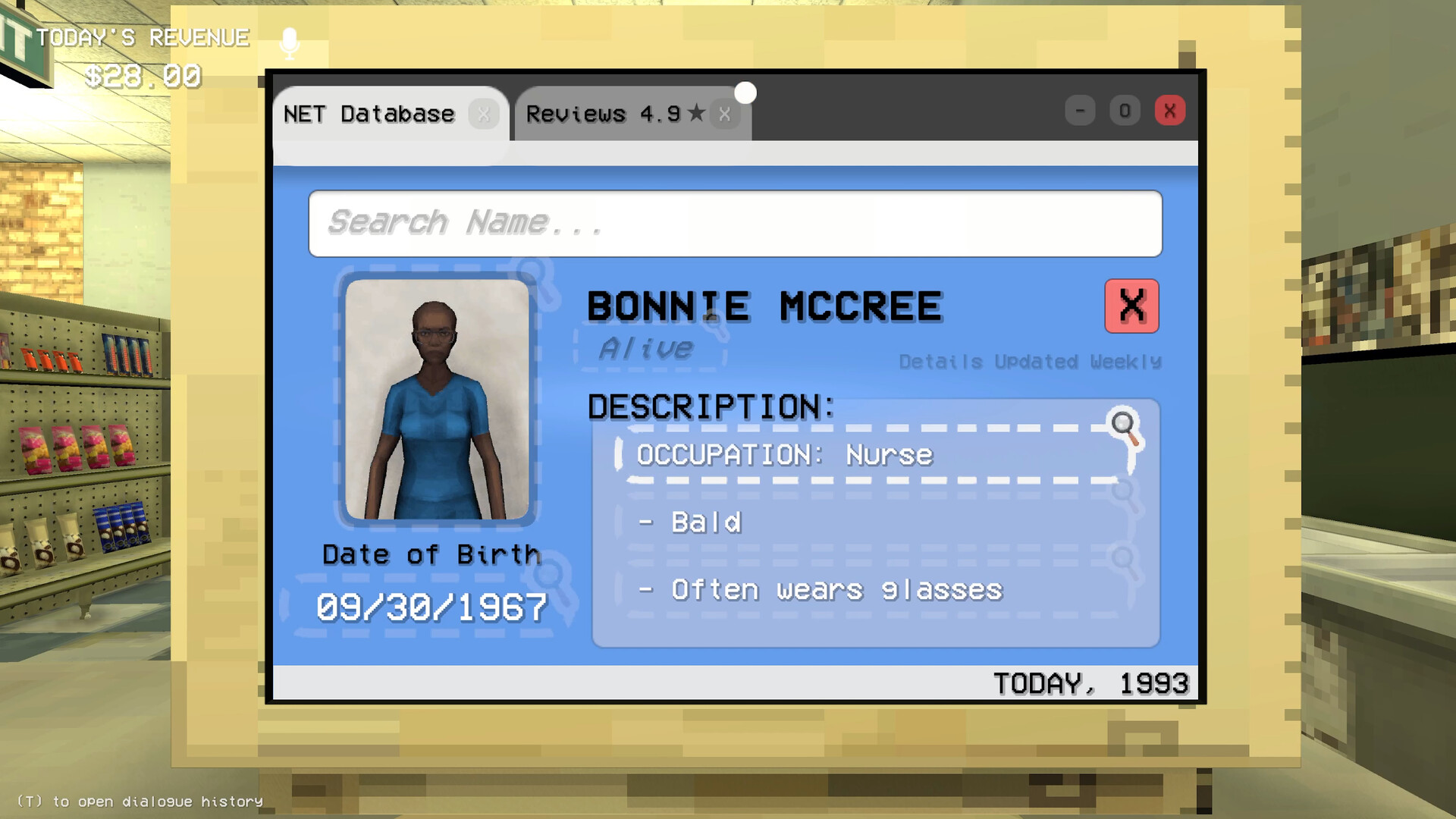
Confirmed evidence channels
The official Steam description names the evidence sources but does not publish a complete list of valid or invalid customer traits. Keep observations separated so one uncertain detail does not become an invented rule.
| Channel | Confirmed use | Not yet confirmed |
|---|---|---|
| Customer ID | Examine the presented ID. | Exact invalid fields, tolerances, or document variants. |
| Computer | Cross-check customer details against in-game records. | Every searchable field, database exception, or failure condition. |
| Behavior | Observe how the customer behaves. | A complete animation, speech, or movement anomaly list. |
| Interrogation | Question customers while serving them. | Guaranteed questions, safe answers, or dialogue scoring. |
A pre-release checking protocol
This protocol is an editorial organization method. It follows the confirmed sources in a stable order but does not claim that the game requires this sequence.
- Read before interpreting. Capture the ID details without deciding what they mean yet.
- Cross-check the record. Compare the available details with the computer rather than relying on memory alone.
- Observe separately. Record behavior as its own evidence channel, not proof by itself.
- Ask and listen. Use the available interrogation options, but do not assume a pre-release dialogue answer is universal.
- State the evidence aloud. In co-op, report facts first and the final in-game recommendation second.
Decision discipline for co-op
Proximity chat makes distance relevant to communication, but the official listing does not document a range, radio system, or UI indicator. Keep the call format short enough to survive an interrupted conversation.
- ID: report only the field that was read.
- Record: say whether the computer check agrees, disagrees, or remains unclear.
- Behavior: describe what happened without assigning an unverified label.
- Call: separate the team recommendation from the evidence that produced it.
The Steam description says suspected non-humans can be executed on site. This is a fictional game mechanic, and exact consequences for a wrong decision are not documented here before launch.
What this page will verify after release
- The exact fields shown on IDs and in the computer database.
- Whether evidence rules vary across the 13 randomized shifts.
- Which behaviors are reliable signals and which are ordinary variation.
- How questioning, team size, and incorrect decisions affect a shift.
- The game version used for every reproducible example.